

When Does an In-House Lens Edger Make Sense for an Optical Shop?
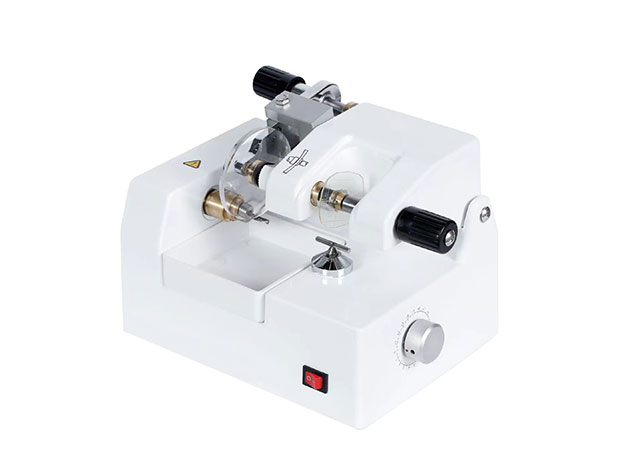
Evaluate an in-house lens edger as a complete work cell, comparing eligible jobs, utilities, staff capability, quality controls, and outsourcing backup.
The purchase makes sense only when your own job data supports the workflow and the shop can fund training, consumables, inspection, and recovery arrangements.
Use the following framework to test operational fit before discussing ownership economics.
Which Jobs Should a Shop Keep In-House and Which Should It Outsource?
Classify jobs by urgency, complexity, repeatability, and risk before deciding which work belongs beside the dispensing floor and which belongs with an external laboratory.
Keep in-house the jobs your team can trace, block, edge, inspect, and deliver consistently; outsource work that exceeds your equipment, training, or quality-control boundary.
Start with a job map
List recent job types from your order records: single-vision and progressive orders if applicable, lens materials, shapes, drill or specialty work, remake patterns, urgent requests, and jobs already sent to a laboratory. For each category, record the actual internal count, turnaround expectation, rework history, material restrictions, and the people currently responsible. This gives the purchase a factual base and shows whether the proposed edger will handle the work that matters rather than an assumed average order.
An in-house decision should cover the whole chain. Tracing must capture the frame shape or pattern; blocking must hold the lens in the intended reference; edging must follow the selected bevel, groove, or other process; and final inspection must compare the result with the order and frame. A machine that performs only one stage does not create a complete in-house capability. If the shop cannot support a step, retain an outsourcing route for it.
The Hongdee Vision lens edger machine page can be used to request current model-specific information. I would ask which jobs, materials, consumables, and upstream or downstream devices the exact model is designed to support. Pairing with a lensmeter may also affect the workflow; Hongdee Vision provides an automatic lensmeter page for that separate verification category. Do not infer compatibility or capability from product names alone.
| Job category | In-house question | Outsource signal |
|---|---|---|
| Routine repeat work | Can trained staff complete and inspect it? | No documented process |
| Complex or specialty work | Does the equipment and training cover it? | Outside the stated boundary |
| Remakes | Can the cause be diagnosed and recorded? | Repeated unexplained rework |
| Urgent orders | Is capacity available without disrupting safety? | Rush would bypass checks |
Keep outsourcing as a capability
Outsourcing is not automatically a failure of ownership. It can protect the shop when a job requires equipment, materials, or expertise not available in-house. Maintain a supplier route, send clear order data, inspect received work, and record reasons for outsourcing. A mixed model may be more resilient than forcing every order through a newly installed edger.
What Equipment and Utilities Are Needed Beyond the Edger?
The edger should be assessed as part of a controlled work cell that includes measurement, tracing or scanning, blocking, inspection, consumables, utilities, workspace, and safe operating procedures.
Confirm the complete installation and process list before purchase: the machine alone does not provide tracing, blocking, lens verification, cleaning, storage, or a backup path.
Draw the work cell
Map the order from received lens and frame through tracing, blocking, edging, cleaning, inspection, and delivery. Identify where measurements originate and where they are checked. Depending on the chosen system, the shop may need a tracer, blocker, lensmeter, suitable work surface, drainage or water handling, ventilation, electrical service, network access, waste handling, and protective equipment. The exact requirements are model-specific and must come from the supplier’s current documentation; I would not fill gaps with generic assumptions.
Space planning should include operator movement, service access, lens and frame staging, clean and dirty zones, and a safe route for customers and staff. A machine that physically fits may still create a poor workflow if staff must carry wet or edged components across the dispensing area. Ask where consumables are stored and how replacement parts are identified. Document environmental requirements, installation responsibility, commissioning steps, and what happens if a utility is unavailable.
Measurement and inspection deserve particular attention. Before edging, the team needs a dependable way to confirm the order and lens data. After edging, staff need a documented inspection for shape, edge condition, mounting fit, surface condition, and order correspondence. A lensmeter can support verification of lens power or other applicable data, but it does not replace every visual and mechanical check.
| Work-cell element | Planning question | Evidence to request |
|---|---|---|
| Tracing and blocking | Where do shape and reference data originate? | Workflow diagram and interface details |
| Edging | Which processes and materials are supported? | Current model documentation |
| Utilities | What power, water, drainage, or network is required? | Installation specification |
| Inspection | How are order, lens, and frame checked? | Internal acceptance checklist |
Plan the unplanned
Ask how the shop will work during cleaning, maintenance, software or electrical interruption, consumable shortage, or an operator absence. “Backup” can mean an external laboratory, a second process, or a controlled delay policy. The important point is to choose it before an urgent order exposes the gap.
How Can Buyers Build a Break-Even Estimate from Their Own Job Data?
Use a transparent variable model built from the shop’s own jobs, outsourcing invoices, labour assumptions, consumables, maintenance, rework, and financing or capital costs.
Treat break-even as an internal calculation framework, not a promised return: replace every variable with documented shop data and revisit the model when assumptions change.
Define the variables
Let the avoidable external cost per job be O. Let the incremental in-house variable cost per job—consumables, utilities, additional handling, and job-specific labour—be V. Let the expected internal job count over the chosen period be N. Let fixed ownership costs for that period—equipment allocation, installation, training, service agreement, and other committed costs—be F. A simple contribution estimate is:
Contribution per in-house job = O − V
Period contribution = N × (O − V)
Framework break-even condition = period contribution ≥ F
This is deliberately a framework, not a forecast. If the shop uses multiple job categories, calculate each category separately because outsourcing cost, consumables, handling time, and rework risk may differ. Add the categories only after stating which jobs are genuinely suitable for the edger. If a job would remain outsourced, it should not be counted as in-house volume merely to improve the model.
Use your actual laboratory invoices and internal time observations. Record whether labour is newly hired, reallocated, or overtime; whether utilities are incremental or shared; and whether maintenance is fixed, usage-based, or uncertain. Include observed rework and unusable-job costs as separately stated inputs rather than hiding them in an optimistic average. Keep the source and date for each input so the buyer can update the model when local costs change.
| Variable | Shop-specific input | Caution |
|---|---|---|
| O | Avoidable external cost per job | Exclude costs that remain after purchase |
| V | Consumables, utilities, labour, handling | Separate by job category |
| N | Eligible in-house jobs in period | Use observed capacity, not hope |
| F | Fixed ownership and setup costs | State timing and inclusions |
Run sensitivity cases
Calculate a conservative, expected, and constrained-capacity case by changing only documented assumptions. Test what happens if eligible volume falls, rework rises, maintenance is delayed, or outsourcing remains necessary for complex work. This shows which variable controls the decision. The result is an operational planning aid, not an ROI promise, payback guarantee, or recommendation to purchase.
What Training, Consumables, and Backup Arrangements Protect the Investment?
Protect the investment with model-specific training, a controlled consumables list, quality records, preventive maintenance, and an outsourcing or alternate-process arrangement.
The safest ownership plan makes competence, supplies, inspection, and recovery responsibilities explicit before the first customer order is placed.
Make competence task-based
Training should follow the work cell: receiving and identifying lenses, tracing, blocking, selecting the correct process, operating the edger, cleaning, inspection, documenting rework, and escalating a job outside the approved boundary. Staff should know which materials and shapes are accepted, what requires approval, and how to stop when an order or equipment condition is unclear. A generic product tour is not enough to establish shop readiness.
Use a sign-off matrix for each role. It can distinguish observed demonstration, supervised practice, and independent operation under the shop’s policy. Include routine cleaning, consumable replacement, safe shutdown, fault reporting, and order verification. Training records should identify the model and procedure version, but they should not be presented as a certification or as evidence of clinical performance.
Consumables need their own stock controls. Record part numbers, compatible models, reorder triggers, storage conditions, and expected lead times from the supplier. Avoid substituting an apparently similar item without confirmation. The Hongdee Vision contact page provides a route for requesting current technical and support information, while the supplier should confirm what is included with the exact machine.
| Protection area | Practical control | Owner |
|---|---|---|
| Training | Role-based supervised sign-off | Operations lead |
| Consumables | Part-number inventory and reorder point | Equipment owner |
| Quality | Pre- and post-edging checklist | Dispensing lead |
| Backup | External lab or alternate process | Store manager |
Make failure recoverable
Define what happens after a failed trace, damaged lens, poor fit, power interruption, machine fault, or staff absence. Record the job, isolate the affected component, contact the responsible support route, and use the approved outsource path when necessary. A resilient shop does not measure ownership success only by routine jobs; it also knows how to protect customers when routine conditions disappear.
Conclusion
An in-house lens edger makes sense only when eligible jobs, work-cell requirements, variable costs, competence, quality checks, and backup capacity are documented. Use your own data to test the decision without turning a framework into a promise.